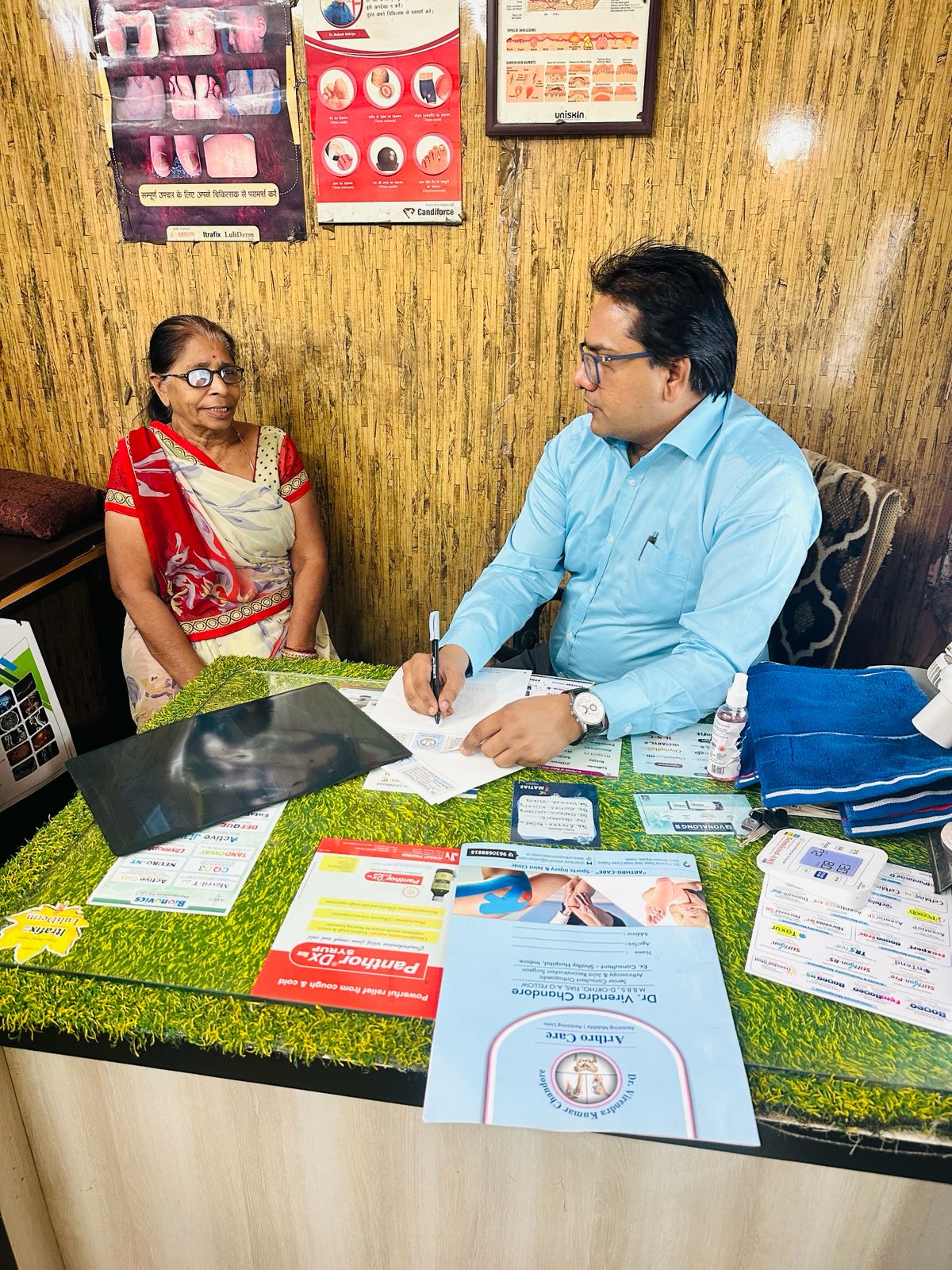
By Dr. Virendra Chandore, Orthopedic Surgeon, Arthocare, Indore
Dr. Virendra Chandore has over a decade of experience as an orthopedic surgeon, with a focus on joint replacement and sports injuries, including knee arthroscopy. He practices at Arthocare, Indore, near Geetabhawan.
A lot of patients come to Arthocare with the same question. Their knee keeps locking, or swelling after every long day, or giving way on the stairs, and someone has told them the word “arthroscopy.” They want to know what it actually means before they agree to anything.
Knee arthroscopy is one of the most common procedures I perform, and it helps a lot of people. It is also not the answer to every knee problem. So in this guide, I’ll explain what knee arthroscopy is, what it treats, what it doesn’t, and what to expect if you’re considering it in Indore.
Looking for a Knee Arthroscopy in Indore visit here.
What Knee Arthroscopy Is
Knee arthroscopy is a keyhole procedure. We make a couple of very small cuts around the knee, about a centimeter each, and insert a thin camera called an arthroscope. The camera sends a live picture of the inside of the joint to a screen, so we can see the cartilage, the ligaments, and the menisci clearly.
If we find something that needs treatment, we use small instruments through the same openings to repair, trim, or remove it. Many procedures that used to need a large cut can now be done this way, which usually means less damage to the surrounding tissue and a quicker return to daily life.
Conditions Knee Arthroscopy Commonly Treats
The most common reason I recommend arthroscopy is a torn meniscus. The meniscus is the cushion of cartilage between the thigh bone and shin bone. When a piece tears and catches inside the joint, it can cause locking, sharp pain on twisting, and swelling. Depending on the tear, we either repair it or trim the damaged part.
A loose body is another common reason. This is a small piece of bone or cartilage floating inside the joint. When it gets caught, the knee can lock suddenly. Arthroscopy is usually the most direct way to remove it.
Arthroscopy is also used for certain ligament injuries, including ACL reconstruction, and for clearing out inflamed joint lining or removing small loose tissue that causes persistent swelling and catching. The procedure itself is the same tool. What changes is the problem we’re treating.
What Knee Arthroscopy Does Not Treat
I want to be direct about this, because it’s where many people get disappointed. Arthroscopy does not reverse advanced arthritis. If the cartilage has worn down across most of the knee, a camera and a few small instruments can’t rebuild it. In those cases, the discussion moves toward physiotherapy, medication, and sometimes knee replacement.
Arthroscopy also isn’t a substitute for rehabilitation. A repaired or trimmed knee still needs strengthening work to hold up well afterwards. Patients who skip physiotherapy often have a less satisfying result, no matter how good the surgery was.
How I Decide Whether You Need It
At Arthocare, I don’t recommend arthroscopy because an MRI shows something. I want to know how the knee is affecting your life. Does it lock during daily movement? Does it give way when you turn? Has physiotherapy and rest helped, and for how long? An image gives me useful information, but it doesn’t tell me how you function, and that matters more.
For some patients, the right answer is a structured non-surgical plan first, especially for smaller tears or mild symptoms. For others, particularly those with clear locking or a loose body, arthroscopy is the sensible next step. I’ll always walk you through both options honestly.
What Happens on the Day of Surgery
Knee arthroscopy is usually done under spinal or general anaesthesia. The procedure often takes between 30 minutes and an hour, depending on what we find and treat. Most patients go home the same day, so you won’t need a long hospital stay.
We close the small cuts with a stitch or two or adhesive strips. Before you leave, we explain what we found, what we did, and what the next few weeks should look like.
Recovery: What to Expect Week by Week
In the first few days, expect some swelling and soreness. Ice, elevation, and prescribed medication help. Most people walk with support within a day or two, and many start gentle movement right away.
In the first two to three weeks, physiotherapy starts in earnest. The goal is to restore full bending and straightening, and to start rebuilding the thigh muscles, which often weaken quickly after knee problems. For a simple meniscus trim, many people return to office work and light daily activity within a week or two, and to more normal activity within about four weeks.
Sports and high impact activities take longer. Running and pivoting usually wait until strength, balance, and confidence are back, often two to three months after surgery or later, depending on what was treated and how you progress. Rushing back is one of the most common reasons for setbacks, so I always set the timeline around your recovery, not the calendar.
Risks You Should Know About
Knee arthroscopy is a safe and well established procedure, but no surgery is risk free. Possible complications include infection, stiffness, blood clots, swelling that lasts longer than expected, and in rare cases, damage to nearby structures. Following aftercare instructions, attending follow-up, and reporting unusual pain, fever, or redness early all help keep the risks low.
IF You want Knee Arthroscopy in Indore visit here.
Common Questions About Knee Arthroscopy in Indore
Is knee arthroscopy a major surgery?
It is a minor surgery in the sense that it uses small cuts and most people go home the same day. It still needs proper planning and a structured recovery.
How long does knee arthroscopy take?
Most procedures take between 30 minutes and an hour. The total time at the clinic is longer because of preparation and recovery monitoring.
Will I need a hospital stay?
Usually not. Most patients go home the same day.
Can I walk after knee arthroscopy?
Yes, most people walk with support within a day or two. Walking normally again depends on the procedure and how your knee responds.
Does knee arthroscopy cure arthritis?
No. It can treat specific problems inside the joint, such as a torn meniscus or a loose body, but it does not reverse arthritis.
When can I drive after knee arthroscopy?
It depends on which knee was operated on and how comfortable you feel controlling the car. We confirm this at your follow-up visit.
My Honest Take
Knee arthroscopy can give people their knee back for everyday life and, in many cases, for the sport they love. It works best when it’s used for the right problem, in the right patient, with proper rehabilitation afterwards.
If your knee is locking, swelling, or giving way, and it’s affecting your daily life, come in for an assessment at Arthocare in Indore, near Geetabhawan. We’ll look at your symptoms, your imaging, and your goals together, and decide honestly whether arthroscopy is the right step for you.
Dealing with knee locking, swelling, or instability? Book a consultation with Dr. Virendra Chandore at Arthocare, Indore, near Geetabhawan, and let’s work out the right plan for your knee.