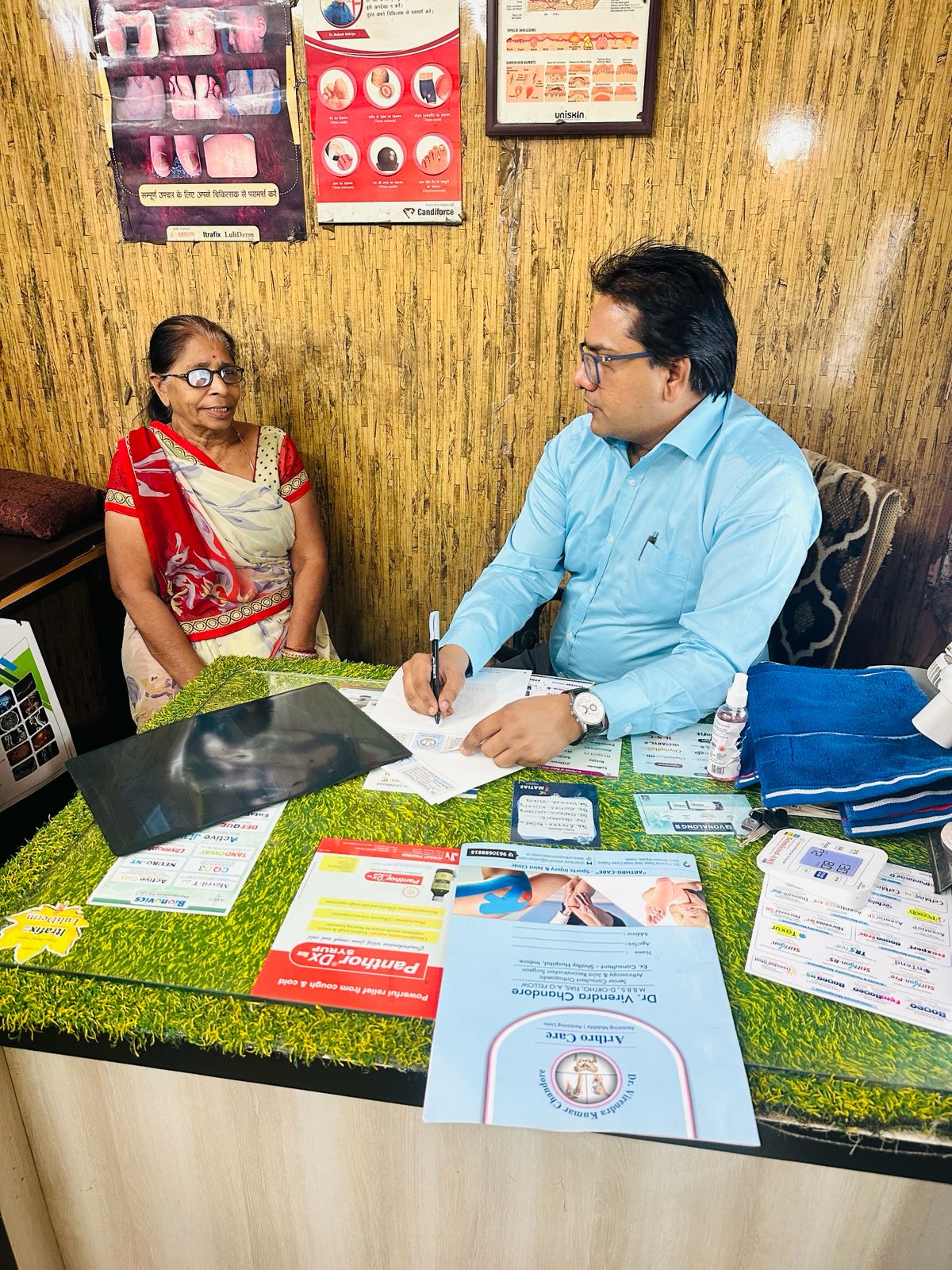

By Dr. Virendra, Orthopedic Doctor, ArthoCare (near Geetabhawan)
“My kneecap just slipped out. What happened?”
Most people who come to our clinic with an MPFL tear tell almost the same story. They were playing football, dancing, or simply turning quickly on the road, and suddenly the knee gave way. Some say the kneecap “popped out and went back in.” Others felt a sharp pain on the inner side of the knee and could barely stand.
If that sounds familiar, you may have an MPFL tear. I am Dr. Virendra, an orthopedic doctor at ArthoCare, near Geetabhawan, and I have treated many patients with kneecap dislocation and knee ligament injuries. In this article I will explain what this injury is, how to recognise it, and what can be done, in simple words.
Looking for a MPFL Tear Treatment in indore visit here.
What is the MPFL?
MPFL stands for Medial Patellofemoral Ligament. It is a thin but strong band of tissue on the inner side of your knee, joining the kneecap (patella) to the thigh bone (femur).
Think of it as a seatbelt for your kneecap. Each time you bend or straighten your knee, the kneecap glides in a groove at the end of the thigh bone. The MPFL stops it from sliding out towards the outer side. In the first 20 to 30 degrees of knee bending, it is the main structure holding the kneecap in place.
When this ligament tears, the seatbelt is gone, and the kneecap can slip out of its groove again and again. This is called patellar instability.
How does an MPFL injury happen?
An MPFL tear almost always happens along with a patellar dislocation, when the kneecap is forced out of its groove.
Common situations include:
- Twisting the knee while the foot is planted (football, cricket, badminton, kabaddi, basketball)
- A direct blow to the inner side of the knee
- A fall or an awkward landing after a jump
- A sudden change of direction while running
Some people are more likely to get this problem. The usual risk factors are:
- A shallow groove at the end of the thigh bone (trochlear dysplasia)
- A high-riding kneecap (patella alta)
- Loose, flexible joints
- Knock knees or other alignment differences
- Weak thigh and hip muscles
- Age and gender: teenagers and young adults, especially young women, see it more often
Having a risk factor does not mean you will tear your MPFL. But if you injure the knee, the chance of the kneecap dislocating again is higher.
MPFL tear symptoms to watch for
Everyone describes it a little differently, but these are the most common signs:
- A feeling that the kneecap moved out and back in
- Pain on the inner side of the knee near the kneecap
- Swelling within a few hours of the injury
- Trouble bending or fully straightening the knee
- Tenderness along the inner edge of the kneecap
- The knee giving way while walking, climbing stairs or playing
- A worried, unsteady feeling when you twist or change direction
Please do not ignore it just because the kneecap went back by itself and the pain settled in a few days. The ligament may still be torn, and that is often when the next dislocation is waiting to happen.
How I diagnose an MPFL tear
I never depend on scans alone. A good diagnosis starts with listening.
- Your story. How did the injury happen? Did the kneecap move? Has it happened before? These details tell me a lot.
- Physical examination. I check for swelling, tenderness over the ligament, and how far the kneecap moves sideways. I also gently push the kneecap outward to see if you tense up with worry. This is called the apprehension test, and it is very telling.
- X-ray. It shows the position of the kneecap, the shape of the groove, and any small bone pieces that broke off.
- MRI scan. It shows the MPFL itself, the cartilage, and any loose fragments inside the joint. It helps me decide whether you need surgery or can recover without it. Sometimes I also advise a CT scan to study the bone alignment.
MPFL tear treatment: do you always need surgery?
No, and this surprises many patients. The right MPFL tear treatment depends on your age, how active you are, how many times the kneecap has dislocated, and what the scans show.
Non-surgical treatment
For a first-time dislocation with no serious cartilage damage and no loose fragments, I usually begin without surgery:
- Rest and protection for the first few days
- Ice and elevation to bring down swelling
- A knee brace or support for a short period
- Physiotherapy to strengthen the thigh, hip and core muscles so they protect the kneecap. This is the most important part.
- A gradual return to activity, not a rush
- Many people do very well with this approach when they follow the rehab properly. Skipping physiotherapy is the most common reason I see the problem come back.
MPFL reconstruction surgery
Surgery may be needed if:
- The kneecap has dislocated more than once
- There are loose bone or cartilage pieces in the joint
- You are a sportsperson and the knee keeps feeling unstable
- Physiotherapy has not worked after a fair trial
- Scans show a bone shape problem that makes repeat dislocation likely
The most common operation is MPFL reconstruction. A torn MPFL usually cannot heal well on its own, so I rebuild it with a graft, most often a strip of your own hamstring tendon. The graft is fixed to the kneecap and the thigh bone, which brings back the “seatbelt.” It is done through small incisions, and in many cases the stay in hospital is short.
If your bone shape is a big part of the problem, an additional procedure may be discussed. I suggest it only when it is truly needed.
MPFL tear recovery time: what to expect
Recovery takes patience. Here is a rough guide, though everyone heals at their own pace:
- First 2 weeks: control pain and swelling, protect the knee, start gentle movement
- Weeks 2 to 6: regain movement, walk with support, begin basic strengthening
- Weeks 6 to 12: build strength and balance, return to normal daily activity
- 3 to 4 months: light jogging and controlled training, if strength and control are good
- 4 to 6 months, sometimes longer: gradual return to sport
- I never clear a patient for sport by the calendar alone. I want to see good strength, steady movement and real confidence in the knee. Going back too early is one of the main reasons for re-injury.
Common mistakes I see
- Ignoring the first dislocation. “It went back in, so I am fine” is a risky thought.
- Skipping physiotherapy. Rehab is half the treatment.
- Returning to sport too soon. Feeling better is not the same as being ready.
- Delaying the consultation. Repeated dislocations can damage the cartilage and lead to early wear in the joint.
- Depending only on home remedies. Rest and hot or cold packs give comfort, but they cannot fix an unstable kneecap.
When should you see an orthopedic doctor?
Book an appointment if:
- Your kneecap has slipped out, even once
- Your knee feels unstable or keeps giving way
- Swelling and pain do not settle within a few days
- You cannot fully bend or straighten the knee
- Something catches or locks inside the knee
- If the knee looks visibly deformed or you cannot move it at all, please go to the nearest emergency department straight away.
About Dr. Virendra
Dr. Virendra is an orthopedic doctor at ArthoCare who treats knee injuries, including kneecap instability, ligament tears and sports injuries. [Add qualifications, e.g. MBBS, MS Orthopaedics, fellowship.] [Add years of experience and hospital affiliations or memberships.]
My approach is simple: explain your problem clearly, show you your scans, and give you options, so you never feel rushed into a decision.
IF You want MPFL Tear Treatment in indore visit here.
Frequently asked questions
Can an MPFL tear heal on its own?
Sometimes the surrounding tissues settle and the knee becomes stable enough with physiotherapy. But the ligament often does not return to its original strength, so a repeat dislocation is possible.
Is MPFL surgery painful?
There is some discomfort afterwards, as with any knee surgery, but it is well controlled with medicines and early physiotherapy. Most patients walk with support quite soon.
How long before I can play sports again?
Usually four to six months, sometimes longer, depending on your strength, control and the type of sport.
Will my kneecap dislocate again?
The risk is real after a first dislocation, especially in young, active people or those with bone shape risk factors. Proper rehab lowers it, and surgery is considered if it keeps happening.
Can I walk with an MPFL tear?
Often yes, once the swelling settles, but the knee may feel unsafe. Being able to walk does not mean it has healed.
Final words
An MPFL tear can feel frightening, but it is very treatable. The key is a correct diagnosis early, sincere rehab, and no rushing back to sport. Whether you need physiotherapy alone or surgery, the goal is the same: a stable, confident knee that lets you return to what you love.
If your kneecap has slipped or your knee feels unsteady, do not wait for it to happen again. Book a consultation with Dr. Virendra at ArthoCare, near Geetabhawan, and get your knee properly checked.